← Back to selected projectsClient case study / 01

PRO BONO CLIENT PROJECT

Godscent Drive POS

A point-of-sale, inventory and event operations system created for a small product business selling through warehouse stock and temporary market locations.

I led the product and engineering work for the functional Version 1, translating business requirements into a private full-stack application.

Client confidentiality

Selected frontend screens are presented with the business owners’ permission. Source code, backend implementation, database details, business rules and operational data remain private.

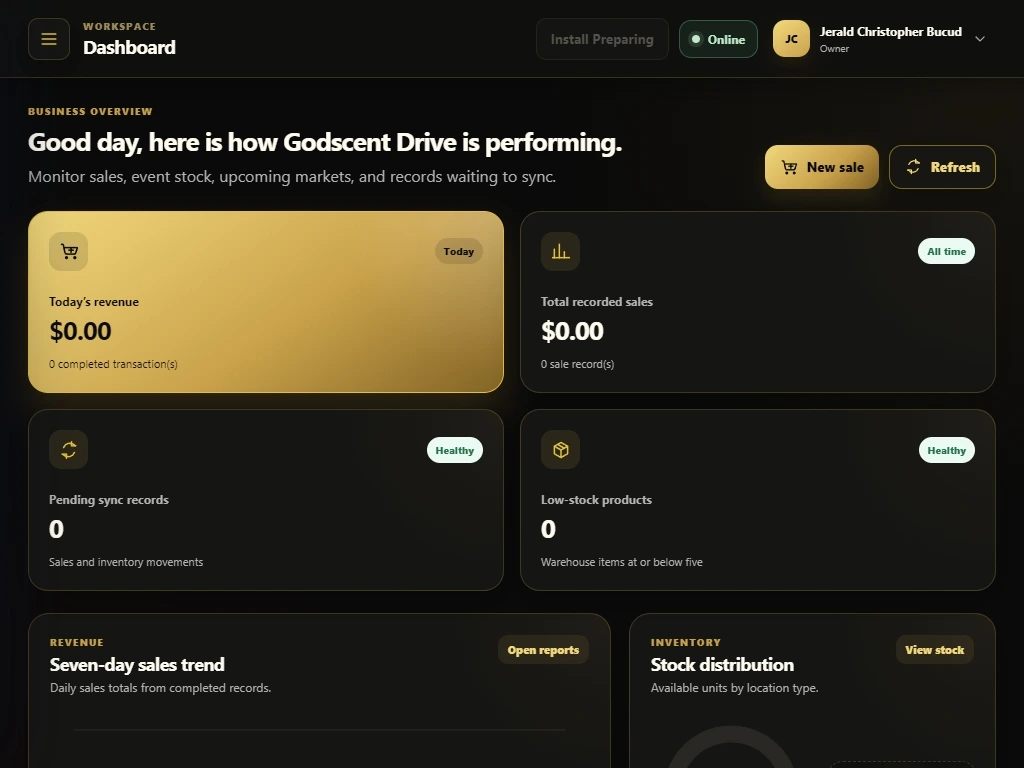
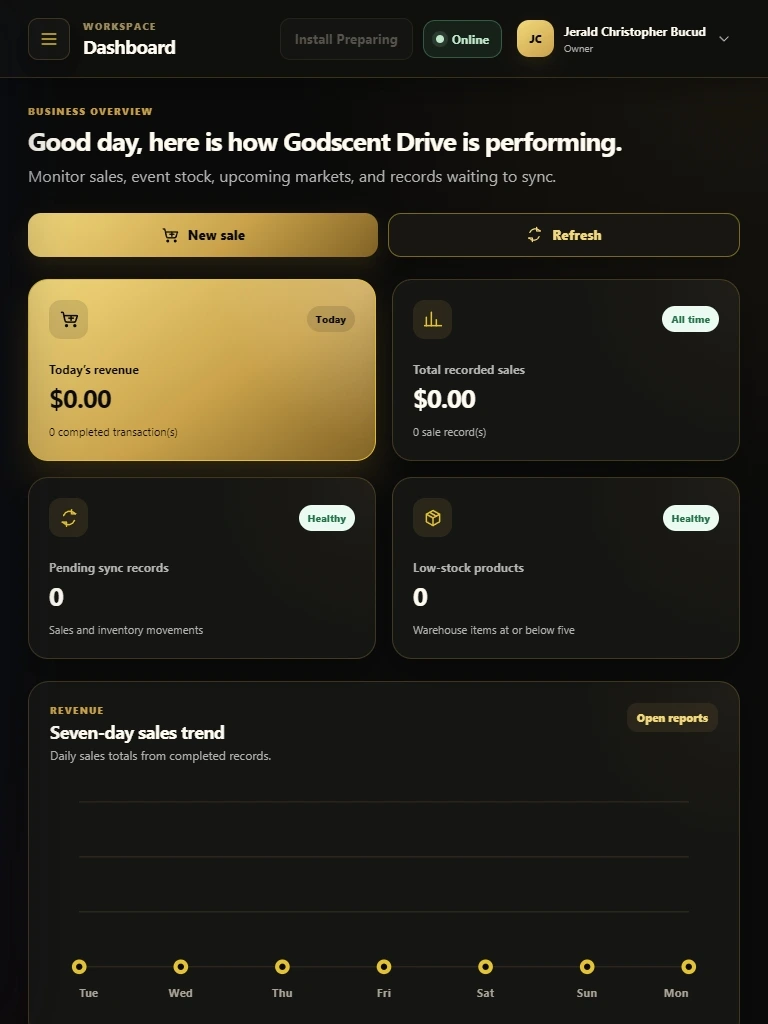
Approved interface / dashboardDemonstration state
Godscent Drive POS dashboard showing sales, stock and event performance panels
The dashboard is shown without customer records, products, inventory figures or live operational data.

01 / CONTEXT

A system shaped around real operations.

Godscent Drive needed to coordinate sales, stock and temporary market events. The design follows the owners’ day-to-day workflow across sales, stock movements and market operations.

The business need

Stock can begin in a warehouse, move to an event, be sold using different payment methods and return after the event. The owners needed one workspace that preserved a reliable record of those movements while supporting everyday sales and reporting.

Connectivity at markets can be inconsistent. Offline storage and later synchronisation are therefore planned for a future implementation phase rather than presented as a completed Version 1 capability.

01

Fragmented records

Sales, stock and event information needed to operate as one connected workflow rather than separate manual records.

02

Multiple stock locations

Warehouse and event stock required clear movement history, balances and controlled returns.

03

Market connectivity

A later phase needs browser-side storage, a retry queue and a defined synchronisation process for periods of weak or unavailable internet access.

04

Sensitive actions

Refunds, voids, configuration and user administration required controlled access and traceability.
02 / SOLUTION

One workspace for the full operating cycle.

Version 1 connects the primary workflows inside one branded internal application while retaining a modular structure for continued development.

01

Sell

Process purchases, record payments, produce receipts and review sales history.

  • New sale workflow
  • Cash and mixed payments
  • Receipt records
  • Sales history
02

Control stock

Track products across warehouse and event locations through explicit stock movements.

  • Products and categories
  • Stock in and adjustments
  • Event load and return
  • Low-stock visibility
03

Run events

Create events, allocate stock, process event sales and review event-level performance.

  • Event setup
  • Event inventory
  • Expense records
  • Performance reporting
04

Govern operations

Protect selected high-impact actions and provide role-aware access for staff.

  • Role-aware navigation
  • User management
  • Refunds and voids
  • Audit logs and settings

03 / RESPONSIVE EXPERIENCE

Designed for the counter, market stall and back office.

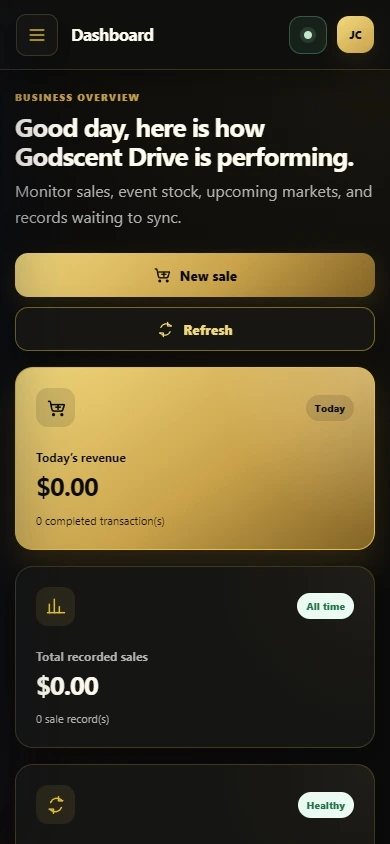
The interface adapts across tablet and mobile layouts so core navigation, operational information and frequent actions remain accessible without relying on a desktop-sized screen.

Approved interface / tablet portraitResponsive layout
Godscent Drive POS interface in a tablet portrait layout with responsive navigation and operational content
The portrait layout provides a focused tablet workspace while preserving navigation and core operational workflows.
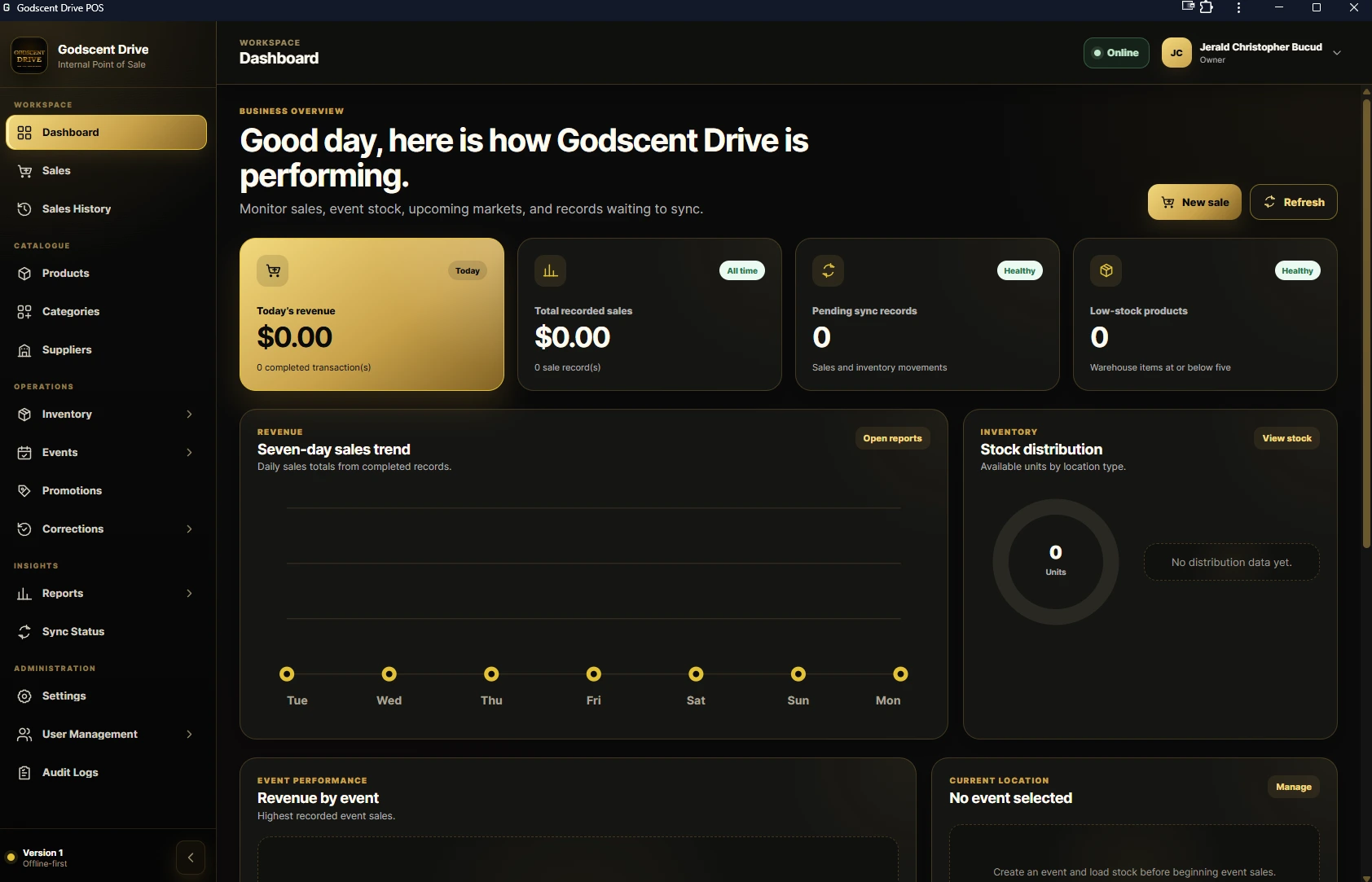
Approved interface / tablet landscapeExpanded workspace
Godscent Drive POS interface in a tablet landscape layout
The landscape layout uses additional horizontal space to present more interface context without changing the workflow.
Approved interface / mobileCompact access
Godscent Drive POS interface adapted for a mobile screen
The mobile layout reduces visual density and prioritises essential information for smaller screens and quick operational access.

04 / ARCHITECTURE

A modular architecture for sales and inventory operations.

The diagram shows the high-level system boundary. Client-specific rules, schema details and operational calculations remain confidential.

High-level system architecturePrivate implementation
InterfaceReact applicationSales · Inventory · Events · Reports
REST
Application layerSpring Boot APIAuthentication · Validation · Business workflows
JPA
System of recordPostgreSQLTransactional records · Flyway migrations
Planned offline extensionIndexedDB and synchronisationBrowser-side storage, retry handling and reconnect synchronisation remain future implementation work.
  • Java 21
  • Spring Boot
  • Spring Security
  • React
  • PostgreSQL
  • JWT
  • JPA
  • Flyway
  • REST APIs

05 / MY CONTRIBUTION

End-to-end ownership across product and engineering.

I worked directly with the owners, modelled their workflows and developed the application across the frontend, API and persistence layers.

01

Requirements and workflow discovery

Turned conversations about selling, stock handling, markets and corrections into defined system workflows and boundaries.

02

Application and data design

Modelled users, roles, products, locations, movements, events, sales, payments, refunds, voids and reporting relationships.

03

Full-stack implementation

Built the React interface, Spring Boot services, PostgreSQL persistence, JWT authentication, role-aware navigation and selected role-restricted backend endpoints.

04

Manual workflow validation

Exercised representative API and interface workflows for sales, receipts, inventory movements, events, refunds, voids and reports while refining the user experience.

06 / ENGINEERING DECISIONS

Technical choices tied to operational risk.

The most important choices were about stock accuracy, understandable transaction state and protection of high-impact actions.

Traceability

Record movements instead of silently editing balances

Inventory changes are represented as movements so the origin of a current balance can be investigated.

Transaction state

Keep synchronisation status in transactional records

Sales and stock movements include synchronisation-status fields. An offline queue and reconnect process still need to be implemented before those fields support end-to-end offline operation.

Access control

Restrict selected high-impact operations

Backend restrictions cover user management, settings, audit logs, suppliers, refunds, voids, promotions, reports and inventory actions. Several core operational routes still require complete authorisation coverage.

07 / STAFF AUTHENTICATION

JWT sign-in and role-aware staff access.

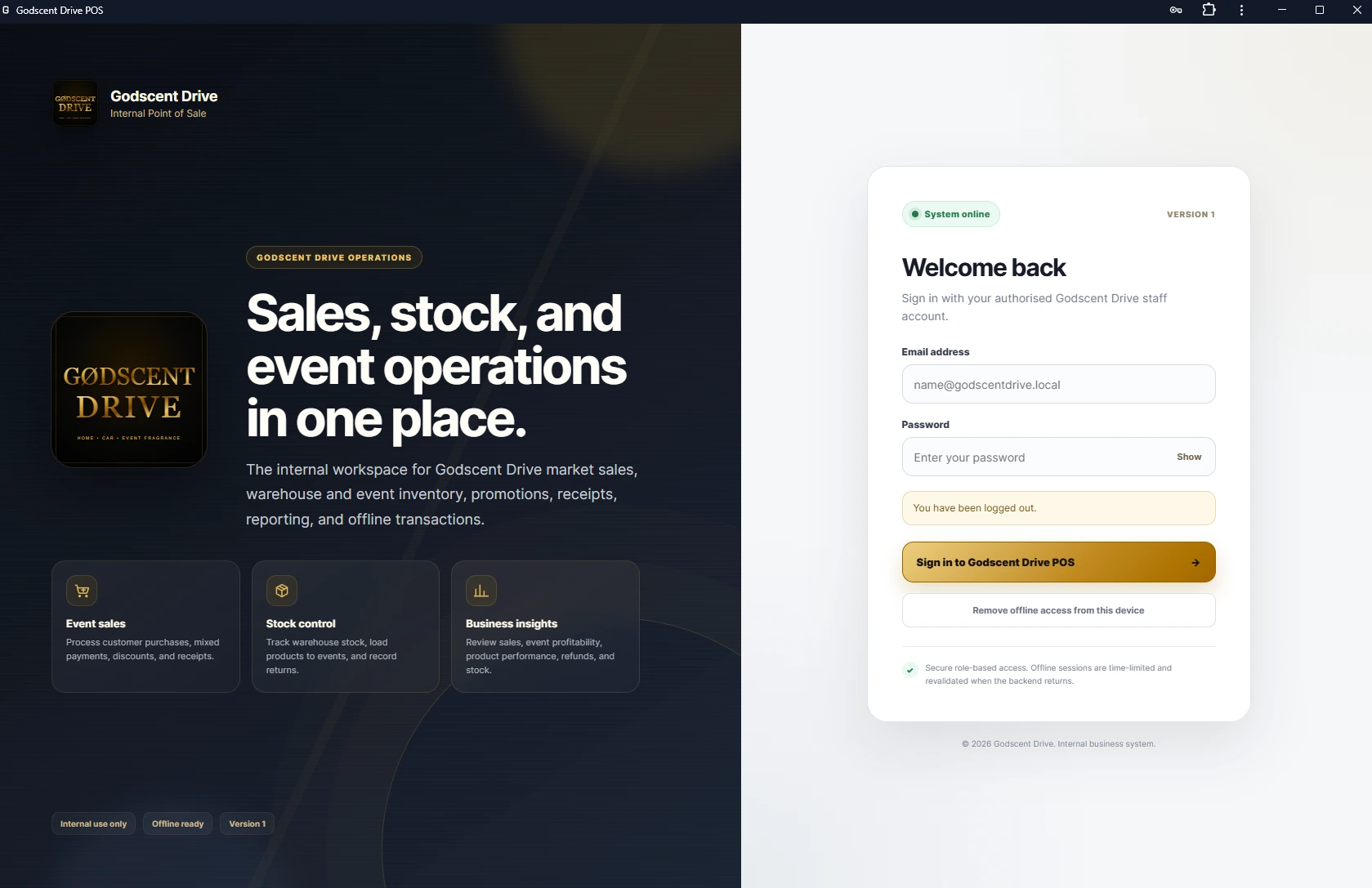
Staff sign in through the Spring Security authentication endpoint. The React application stores the returned token, sends it with API requests and limits client-side routes according to the user’s recorded role.

Approved interface / sign inStaff access
Godscent Drive POS login screen showing branded business information and a staff sign-in form
The sign-in screen provides credential-based staff access without exposing credentials or business data.

08 / DELIVERY

From business conversations to a functional Version 1.

The project followed an iterative cycle of discovery, modelling, implementation, manual workflow checks and interface refinement.

  1. 01

    Discover

    Understood how the owners sell, move stock, operate markets and review results.

  2. 02

    Model

    Converted business workflows into system entities, permissions and transaction boundaries.

  3. 03

    Build

    Implemented the interface, services, persistence and authentication controls.

  4. 04

    Validate

    Manually checked representative API and interface workflows and corrected issues found during development.

  5. 05

    Refine

    Improved navigation, dashboard visibility, branding and system feedback.

09 / OUTCOME

A connected operational foundation for the client.

Version 1 brings requirements discovery, business modelling and full-stack delivery into connected workflows across sales, inventory, events and administration.

01Central workspace

Core sales, stock and event operations are represented in one internal application.

02Connected transactions

Sales link to payments, receipts, stock effects, corrections and reports.

03Operational visibility

The dashboard surfaces sales totals, warehouse and event stock, planned events and recent stock movements.

04Extensible foundation

The modular frontend, API and database structure support continued development.

10 / CURRENT SCOPE

Current constraints and next improvements.

Version 1 supports the core connected workflows. The next phase focuses on offline capability, broader automated testing, complete backend authorisation and structured client feedback.

Current constraints

  • The application is private and has no public live demo.
  • Automated testing currently consists of an application-context test; broader unit and integration coverage has not yet been added.
  • IndexedDB storage, an offline queue and reconnect synchronisation are planned but not implemented end to end.
  • Several core API routes remain temporarily accessible while complete backend authorisation is being integrated.

Planned next steps

  • Implement IndexedDB storage, retry handling and reconnect synchronisation for market use.
  • Add unit, integration and security tests for sales, inventory and access rules.
  • Complete backend authorisation across the remaining operational routes.
  • Collect structured usability feedback from the owners and prepare production monitoring.
Private repository

Client-specific implementation remains confidential.

The source remains private because the application contains client-specific workflows and business logic. I can discuss its architecture, development process and selected engineering decisions during an interview while respecting the owners’ confidentiality.

CASE STUDY 01

Explore the rest of the portfolio.